
Prepare for Magnetic Resonance Imaging (MRI)
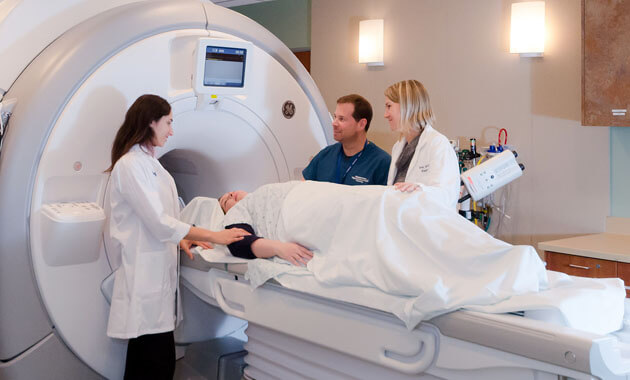
An MRI exam captures detailed internal images of a specified part of your body to help your doctor learn more about your condition. For the radiologist to obtain these images, a large tube-like machine uses a strong magnet and radio waves to get information that produces images with the aid of a computer. You will be asked to remain very still inside the machine during this process.
Before your visit
To help you understand what to expect and feel comfortable about your upcoming MRI, we will email you an online informational video to view in advance. You can also learn more about the process on at radiologyinfo.org and on our website.
Before your exam, you will need to complete our MRI screening questionnaire to make sure the MRI staff, technologist and radiologist have essential information about any implants or other conditions they need to be aware of. The questionnaire will be available in MyChart prior to your appointment and during check-in the day of your exam.
Arrival time
If you are running late on the day of your exam, please call the specific UCSF Radiology location where your exam is scheduled to see if your appointment can still be accommodated.
If you need to reschedule your exam, please call UCSF Radiology Scheduling at (415) 353-3900.
If your doctor has prescribed medication to prevent claustrophobia or if you will require anesthesia to help you tolerate the MRI, or if you have a pacemaker, you will require additional time to prepare for the exam.
For pediatric or adult patients requiring anesthesia will receive a phone from a staff member a few days in advance of your appointment to set an earlier arrival time.
Length of appointment
Plan on at least 1.5 to 2 hours for your MRI exam from check-in to checkout. If your doctor has ordered multiple exams, your appointment may take longer.
Sometimes we encounter unexpected delays, due to emergencies or appointments that take longer than anticipated. We do everything we can to keep things running smoothly and on time, and we will give you the time you need for a thorough exam. However, we recommend leaving enough time between your MRI exam and other appointments or obligations. We also recommend bringing reading material with you in case you need to wait.
The day of your exam
MRI usually requires no dietary changes or other special preparations. Unless indicated in your exam preparation instructions in MyChart, you can eat and drink and take your regular medications as usual.
If you wear a medication patch or glucose monitoring patch it will need to be removed at the time of your exam for your safety. Before your exam, talk to your physician about removing and discarding your patch. Your physician can advise you about replacing your patch after the scan.
During the exam
After you’ve been checked in for your MRI, you can expect the following:
- Radiology staff will verify your identification and the exam requested.
- You will be asked to change into a hospital gown, pants, robe, and socks and place your clothes and belongings in a locker. Leave valuables at home, including jewelry, to prevent from being lost. None can be worn during the scan.
- If you wear hearing aids, you will be asked to remove them before entering the MRI scan room and should inform the technologist when you have done so. The magnetic field generated by the MRI can cause damage to hearing aids.
- Some MRI exams include use of injected contrast agent to highlight features in an image and help radiologists diagnose medical conditions. If an injected MRI contrast agent is needed for your imaging, an IV catheter will be inserted in your arm by a nurse or technologist.
- You will be required to lie completely still during the MRI exam. Depending on the body part being imaged, you may be instructed to hold your breath for up to 30 seconds at a time.
- The magnet tube is open on both ends. The enclosure is well lit and there is a fan for comfort. You can communicate with the technologist through an intercom system during the exam. The part of the body being scanned will be positioned in the middle of the machine.
- During the actual imaging, you will hear loud intermittent noises. You will have been given earplugs or headphones to lessen the noise. If you have trouble keeping these in place, please tell the technologist.
- You will also have an alarm button to alert the technologist to any significant discomfort you may feel at any point during the exam.
- If you are receiving an injected MRI contrast agent, tell the technologist if you feel any discomfort from the IV during the exam.
After the exam
- Radiology staff will bring you back to your locker and you can change back into your clothes.
- If injected contrast agent was used, the IV will be removed from your arm before you go home.
- If you took medication to prevent claustrophobia or were given anesthesia, you must have someone else drive you home.
- Allergic reactions to contrast materials are extremely rare – but if you notice any symptoms such as rash, hives or shortness of breath before you leave the facility, notify the technologist or radiology staff immediately. Or call your doctor or go to the nearest hospital if you have already left to go home.
Learning your results
Your MRI will be interpreted by a UCSF radiologist, who will then write a report detailing the findings in your exam. After the report is finalized – typically within two to five working days – you can access this report and your images in MyChart.
Please note, because your results are available in MyChart immediately after they are finalized by the Radiologist, your care team may not have yet reviewed the report.
Notifications about new test results are sent to patients via MyChart once daily between 8 and 9 a.m., Monday through Friday (excluding holidays). If you’d rather receive notifications as soon as test results are available, you can update your preferences in MyChart.
If you’re not on MyChart, you can sign up online. For any assistance you need signing up, contact MyChart Customer Service at (415) 514-6000.
Understanding your results
Your report may contain complex words and information. You can discuss your results with your care team at your next visit, by telephone, or with MyChart messaging. If you do not have a visit scheduled and need to schedule one, please contact your referring provider through MyChart or by calling the referring provider’s office directly.
How can I help prepare my child for an MRI scan?
For pediatric patients requiring Child Life Services, the responsible family member will be contacted with instructions for an earlier arrival time.
For pediatric patients requiring anesthesia, the responsible family member will be contacted with instructions for an earlier arrival time.
MRI examinations require that the patient hold still for long periods of time. We provide MRI-compatible CinemaVision goggles (which are found in very few imaging centers) so that our young patients can watch movies during their MRI procedure. Patients can either choose a movie from our movie list or bring one from home. Watching an entertaining movie helps children remain comfortable and still, and it minimizes the need for anesthesia.
We invite our younger patients to watch this video to get ready for their MRI:
Important Safety Guidelines for Individuals Who Must Accompany an MRI Patient
For safety reasons, only the patient is allowed inside the MRI scan room.
However, in some cases — such as young children or patients who need extra support — a companion may be allowed inside the scan room.
If you accompany someone into the MRI scan room, you must follow the same safety rules as the patient. These include
- completing an MRI safety screening
- changing into a medical center provided gown/pants, and
- personal item restrictions
You’ll be asked to store all personal items such as cell phones, purses, bags, backpacks and jewelry in a patient dressing room locker before entering the scan room.
For pediatric patients, having a parent or guardian present can help reduce anxiety and make the experience less intimidating. Plus, wearing the same special MRI-safe clothing often creates a fun sense of togetherness!
Thank you for helping us keep everyone safe during the MRI process.
Refer a Patient
Radiology Scheduling
Ph: (415) 353-3900
Fax: (415) 353-7299
Interventional Radiology Scheduling
(415) 353-1300
Neuroendovascular Surgery Scheduling
(415) 353-1863
MyChart
Billing & Insurance
(415) 514-8888